







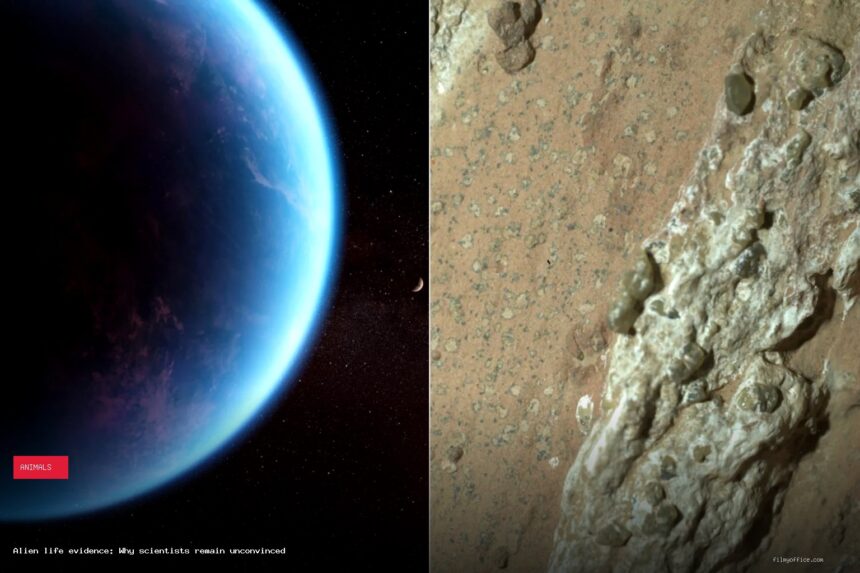
Quick answer: A survey of astrobiologists found limited support for two possible alien-life discoveries announced in 2025. Only 6.6% thought possible molecules on K2-18b probably represented extraterrestrial life, compared with 15.1% for mineral patterns in a Martian rock; neither announcement established a confirmed discovery.
Has alien life evidence finally delivered a discovery? Two announcements in 2025 raised hopes, but a survey of astrobiologists found that most remained unconvinced. Possible biological molecules on the exoplanet K2-18b and intriguing mineral patterns in a Martian rock were not widely regarded as probable evidence of extraterrestrial life.
Only 6.6% of surveyed experts thought the possible molecules on K2-18b probably represented alien life. For the mineral patterns in the Mars rock, the figure was higher at 15.1%—but still a minority.
Those results draw a distinction between a promising clue and a discovery. Both announcements concerned possible signs of life, rather than confirmation that life had been found beyond Earth.


What made K2-18b a focus of attention?
In April 2025, researchers reported possible traces of dimethyl sulfide and/or dimethyl disulfide on K2-18b. On Earth, these molecules are associated with biological activity, making the reported traces relevant to the search for extraterrestrial life.
A press release described the finding as the “strongest hints yet” of extraterrestrial life on the exoplanet. The announcement attracted extensive coverage, with many accounts presenting it as an extraordinary advance.
The expert survey captured a more cautious response. Just 6.6% of respondents thought the possible molecular evidence probably represented extraterrestrial life—a much narrower endorsement than the excitement surrounding the announcement might suggest.

The wording matters here: researchers reported possible traces of molecules associated with life on Earth. That is not the same claim as having established that organisms exist on K2-18b.
Why a rock on Mars prompted another wave of excitement
The second announcement followed in September 2025. NASA said a Martian rock called Cheyava Falls appeared to preserve a potential biosignature, or possible sign of life.
The features drawing attention were mineral rings described as “leopard spots”. NASA’s Perseverance rover captured an image of these markings, which can be associated with microbial activity on Earth.
Discussing a collected sample from the rock, NASA Administrator Sean Duffy called it the “closest we have ever come” to discovering life on Mars. The statement underlined the significance attached to the find, while stopping short of announcing a confirmed discovery.
Among the surveyed experts, 15.1% thought the intriguing mineral patterns probably represented extraterrestrial life. That was a larger share than for the K2-18b finding, but most astrobiologists remained unconvinced in this case too.
What the survey tells us—and what it does not
The researchers surveyed astrobiologists shortly after the two announcements to examine how expert judgments were distributed across the field. The aim was to look beyond the handful of expert reactions that often accompany a prominent scientific claim.
Individual responses can offer useful insight without showing what the wider research community thinks. Here, the percentages provide a clearer picture of how the surveyed specialists assessed these two possible signs of extraterrestrial life.
These are measures of expert opinion about particular findings, not percentages expressing the chance that alien life exists. They also do not turn either potential biosignature into a confirmed detection.
For anyone asking whether these announcements mean alien life has been found, the answer is that neither established such a discovery. The clues generated considerable excitement, but the survey shows that most of the astrobiologists questioned were not persuaded that either probably represented life beyond Earth.
Frequently Asked Questions
Have scientists confirmed alien life from these findings?
Neither announcement established a confirmed discovery of extraterrestrial life. Both concerned possible signs of life, and most surveyed astrobiologists remained unconvinced.
What possible signs of life were reported on K2-18b?
In April 2025, researchers reported possible traces of dimethyl sulfide and/or dimethyl disulfide on K2-18b. These molecules are associated with biological activity on Earth.
Why are the leopard spots in the Cheyava Falls rock significant?
The spots are mineral rings that can be associated with microbial activity on Earth. NASA announced in September 2025 that the Martian rock appeared to preserve a potential biosignature, but only 15.1% of surveyed experts thought the patterns probably represented extraterrestrial life.