







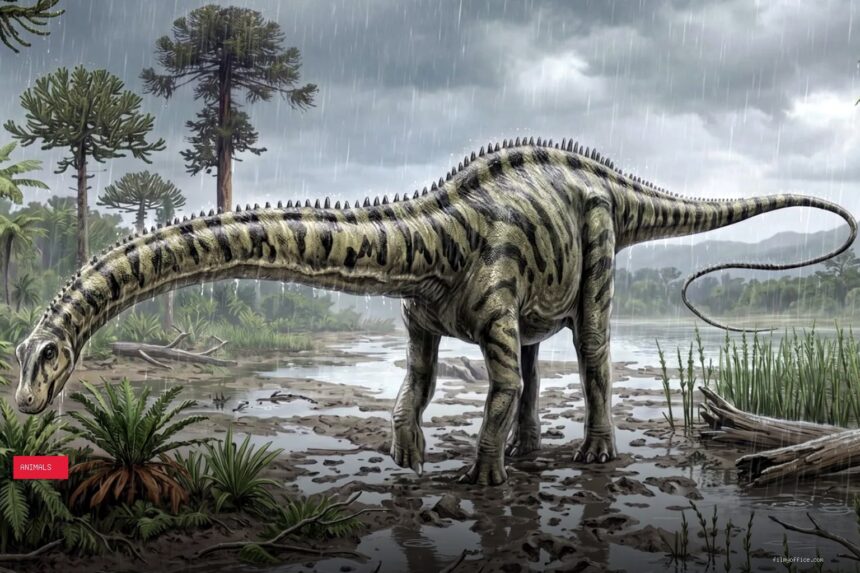
Quick answer: Paleontologists have identified a 150-million-year-old Diplodocus fossil in Spain, the first confirmed discovery of the genus outside North America. Distinctive features in well-preserved tail bones supported the identification, while the find suggests dinosaur movement between Europe and North America during the Late Jurassic.
The identification of Diplodocus in Spain has extended the dinosaur’s confirmed range beyond North America for the first time. About 150 million years old, the fossil remains belong to a giant sauropod estimated to have measured around 25 metres long.
Paleontologists identified the dinosaur through distinctive features preserved in its tail bones. The discovery offers evidence that these animals ranged farther than previously confirmed, while raising questions about how dinosaurs moved between continents during the Late Jurassic.
A Spanish excavation changes the picture
The fossils came from the La Tejería site in El Castellar, Teruel, Spain. A team from Fundación Dinópolis recovered 14 exceptionally well-preserved caudal, or tail, vertebrae, together with several chevron bones.


Before this identification, every confirmed Diplodocus specimen had come from the Morrison Formation in the western United States. The Spanish material therefore marks a geographical first for the genus, rather than simply another discovery of the familiar long-necked dinosaur.
Researchers from the Fundación Conjunto Paleontológico de Teruel-Dinópolis described the fossils in a peer-reviewed study. The specimen also ranks among the most complete diplodocid skeletons uncovered in Europe, with the well-preserved tail material providing crucial anatomical evidence.
How the team identified Diplodocus
Sergio Sánchez Fenollosa, the study’s lead author and a PhD student in biodiversity and evolutionary biology at Fundación Dinópolis, described the team’s response: “We are delighted with this discovery.” The identification emerged through a detailed study of the bones and a series of evolutionary analyses.
“It was an exciting and continuous process of seeing the pieces of the puzzle gradually fall into place. From the early stages of the osteological study, we noticed strong similarities with several diplodocine sauropods,” Sánchez Fenollosa said.
Those early similarities became more specific as the researchers examined the anatomy. Rather than relying on the animal’s size or a general resemblance, the team identified a combination of features characteristic of Diplodocus.
“As we looked more closely at the anatomy, we began to identify a combination of features characteristic of Diplodocus species. Then, as we carried out different evolutionary analyses, they kept pointing in the same direction,” Sánchez Fenollosa explained.
He described the result plainly: “With each new result, the picture became clearer: we were looking at a Diplodocus.” The agreement between the anatomical observations and the evolutionary analyses supported the identification of the Spanish remains.
What the discovery suggests about ancient travel
The significance goes beyond adding Spain to the dinosaur’s known range. The presence of Diplodocus in Europe suggests movement and exchanges of dinosaur populations between Europe and North America during the Late Jurassic.
Temporary land connections are one possible explanation for that movement. That remains a proposed route, however, rather than a confirmed journey established by the Spanish fossils.
The distinction matters: the bones provide the first confirmed evidence of Diplodocus outside North America, while the route that brought these dinosaurs between continents remains a question. For now, the La Tejería specimen establishes that this enormous sauropod was not confined to the North American fossil record.
Frequently Asked Questions
Where was the first Diplodocus outside North America found?
The fossils were found at the La Tejería site in El Castellar, Teruel, Spain. Previously, every confirmed Diplodocus specimen had come from the Morrison Formation in the western United States.
How did scientists identify the Spanish fossil as Diplodocus?
Researchers examined 14 exceptionally well-preserved tail vertebrae and identified a combination of anatomical features characteristic of Diplodocus. Evolutionary analyses also supported the identification.
How old and how large was the Diplodocus found in Spain?
The fossil is about 150 million years old, dating to the Late Jurassic. The dinosaur was estimated to have measured around 25 metres long.